Old Sow is a tidal whirlpool in the Western Passage between Eastport, Maine and Deer Island, New Brunswick. NOAA calls it the largest whirlpool in the Western Hemisphere. Here is where it is, how big and how deep it is said to be, when it forms, and where the published sources disagree.
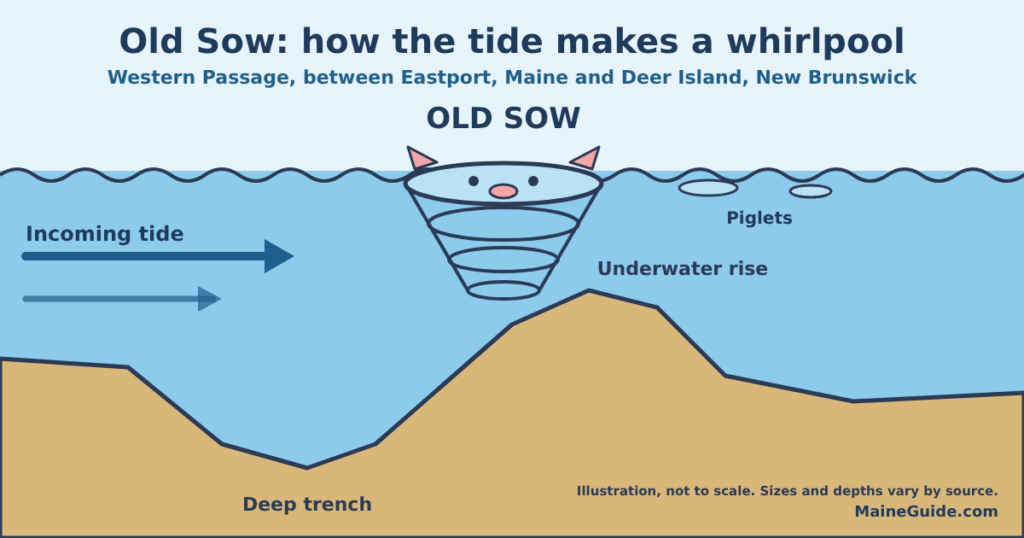
Photo: NOAA Ocean Service. NOAA says its web content is public information unless noted otherwise, and this photo has no other credit on its page.
Where Old Sow is
Old Sow forms in the Western Passage of Passamaquoddy Bay, near the mouth of the Bay of Fundy, between Moose Island, where Eastport sits, and Deer Island, New Brunswick, according to NOAA and Fishermen’s Voice. A Fishermen’s Voice photo caption puts it about 1,500 feet east of Moose Island.
BayofFundy.com says that on the incoming tide the whirlpool shows off the southwestern tip of Deer Island and can be seen from the Deer Island Point side. On the outgoing tide, it says, a weaker whirlpool forms south of Deer Island near Indian Island, New Brunswick. Its 2011 article says Old Sow is sometimes visible from land and is best seen from a charter boat with a qualified captain.
How big is Old Sow?
Most sources say about 250 feet across. Here is how each puts it:
- NOAA: measured at more than 250 feet in diameter, which it compares to the length of a soccer field.
- BayofFundy.com: the turbulent area has been reported to reach 76 meters, or 250 feet.
- Fishermen’s Voice: about 250 feet, a figure it says came from a 1997 aerial photo that used the Deer Island Point Light tower as a known-width reference. The photographer is not named.
- Tom Seymour, in the same article: describes a whirlpool he entered as 50 feet across, and says he is not sure whether it was Old Sow or one of the smaller whirlpools nicknamed piglets.
The 2011 BayofFundy.com article also says its estimate came from an aerial photograph taken in the late 1990s. Wikipedia adds that it was a 1997 estimate by the president of the Old Sow Whirlpool Survivors’ Association, using an aerial photo calibrated against the Deer Island Point Light tower, and it gives no other diameter. Three sources that explain a method point to that one photo, so the 250-foot figure repeated across sites may be a single estimate rather than repeated measurements. We could not find a newer measurement, and we have not seen the photo.
Two other points affect the number. BayofFundy.com says the broad area of turbulence is larger than the main whirlpool and should not be confused with it. A Fishermen’s Voice caption says Old Sow’s size, speed and location vary with the height of the tide.
Is Old Sow the largest whirlpool in the Western Hemisphere?
NOAA says so in plain words, and NewsCenter Maine repeats it in its headline, though its article does not say who first made the claim. Fishermen’s Voice and BayofFundy.com go further and call Old Sow the second largest whirlpool in the world, and BayofFundy.com names the Maelstrom of Norway as the largest.
None of these says who ranked the world’s whirlpools or by what method. We did not find a published list that measures them the same way, so we would treat “largest in the Western Hemisphere” as the standard description, not a measured ranking.
How deep is the water under Old Sow?
- NewsCenter Maine: the water is about 300 feet deep, with an underwater hill about 250 feet tall beneath it.
- BayofFundy.com: a trench as deep as 122 meters (400 feet), rising to 36 meters (119 feet) before dropping again to more than 107 meters (350 feet).
- NOAA: names a deep trench and an underwater mountain but gives no depth. It says some boaters have narrowly avoided a 12-foot drop into the whirlpool.
These numbers describe different places along the passage, and none of the pages we read names a chart or survey, so we cannot reconcile them. What they share is a bottom with a deep trench and an underwater rise, which NOAA says help pinch part of the incoming tide into the whirlpool.
When does Old Sow form?
NOAA, NewsCenter Maine and BayofFundy.com tie it to the incoming tide, while Fishermen’s Voice says conditions favor whirlpools with each change of tide. BayofFundy.com says it is most active about three hours before high tide and that this lasts about two hours. It adds that Old Sow is strongest around spring tides, which come near the full and new moon, and when high winds or a tidal surge coincide. NOAA and NewsCenter Maine give no times.
BayofFundy.com says it usually shows up as small gyres, troughs, spouts and holes, and only occasionally as one large funnel. WorldAtlas says its size and intensity vary and that a dramatic formation is not guaranteed on any visit.
Is Old Sow dangerous?
The sources split by the kind of boat. NOAA says Old Sow is dangerous to small-craft mariners. NewsCenter Maine quotes charter captain Skip Harris saying it is not a navigation hazard but can kick a boat around. Fishermen’s Voice says motorized vessels are unlikely to suffer harm while sail and human-powered craft stay at high risk.
Fishermen’s Voice also recounts incidents, which we have not verified:
- 1835: the schooner Quickstep was reported sunk.
- 1995: the 55-foot Fundy Star II rolled over, and all three crew were rescued.
- December 2009: two recreational divers were caught. One swam to shore and the Coast Guard rescued the other.
The same article also lists drownings in 1912 and 1944. BayofFundy.com recommends going out with a charter and a qualified captain.
Why is it called Old Sow?
Nobody has established the origin. NewsCenter Maine says oral history ties the name to the pig-like or sucking sounds the whirlpool makes, and the smaller whirlpools around it are called piglets. BayofFundy.com and Fishermen’s Voice say it most likely comes from “sough,” an old English word for a drain or a sucking sound, which may have shifted to “sow” through similar spellings such as “plough.”
Why the sources disagree
- Size. NOAA says more than 250 feet and others say 250. The sources that explain a method point to one 1997 aerial photo, so the number may be one estimate repeated, and the whirlpool changes with the tide.
- Depth. The 300, 400, 119 and 350-foot figures appear to describe different spots, and none of the pages we read names a survey.
- Ranking. NOAA says largest in the Western Hemisphere. Other sources say second largest in the world without naming who ranked them.
- Danger. NOAA warns small craft, a charter captain says it is not a hazard, and Fishermen’s Voice separates motorized boats from sail and human-powered ones.
Old Sow whirlpool: FAQ
Where is the Old Sow whirlpool?
In the Western Passage of Passamaquoddy Bay, between Eastport, Maine and Deer Island, New Brunswick, near the mouth of the Bay of Fundy.
How big is Old Sow?
NOAA says more than 250 feet across. BayofFundy.com and Fishermen’s Voice say about 250 feet, a figure that traces to a late-1990s aerial photo.
When can you see the Old Sow whirlpool?
Mainly on the incoming tide. BayofFundy.com puts the peak about three hours before high tide, lasting about two hours, and says spring tides make it stronger. Check a local tide table, because we have not verified these times.
Is Old Sow the largest whirlpool in the world?
Not by any source we found. NOAA calls it the largest in the Western Hemisphere, and BayofFundy.com and Fishermen’s Voice call it second largest in the world behind Norway’s Maelstrom.
Our details come from NOAA, NewsCenter Maine, BayofFundy.com and its 2011 article, Fishermen’s Voice, WorldAtlas and Wikipedia. We have not independently verified these figures, and we have not found an original measurement of the whirlpool.