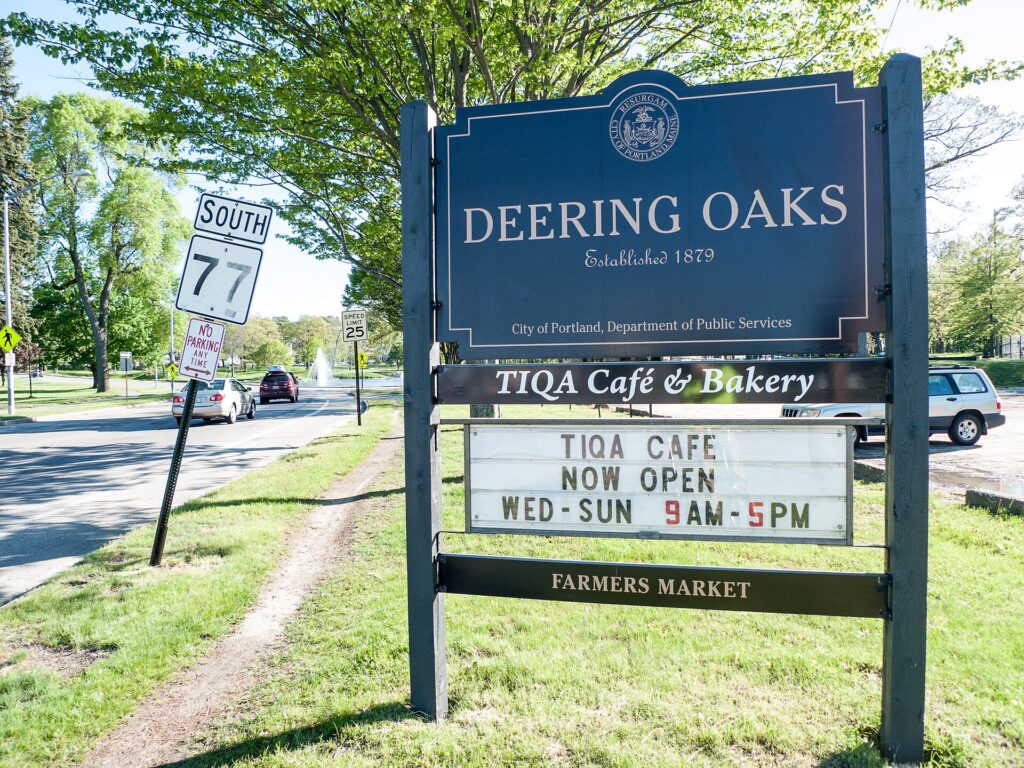
Deering Oaks is a 55-acre park just west of downtown Portland, with a pond, a ravine with a splash pad, tennis and pickleball courts, a playground and the Saturday farmers’ market. Here is what is there, how the park came to be, and the details the sources do not agree on.
Deering Oaks Park at a glance
- Size: 55 acres (22 hectares), according to Wikipedia.
- Where: west of downtown Portland. It is bordered by Deering Avenue on the west, Forest Avenue on the east, Park Avenue on the south and Interstate 295 on the north. State Street and High Street cross it.
- Established: 1879, as part of Frederick Law Olmsted’s master plan for Portland’s park system, per Wikipedia.
- Historic listing: National Register of Historic Places, October 16, 1989.
- Friends group: the Friends of Deering Oaks is a non-profit citizen organization that works to preserve and enhance the park.
History of Deering Oaks
Wikipedia says the land was part of a Deering family estate from the early 19th century. In 1875 the family proposed giving the city 50 acres in exchange for a tax abatement, and the city formalized the agreement in 1879. William A. Goodwin, the city engineer, oversaw the park’s development. The site is older than the park: in September 1689, during King William’s War, settlers were defended there in the Battle of Brackett’s Wood. A small northern section was lost to Interstate 295 in the mid-20th century.
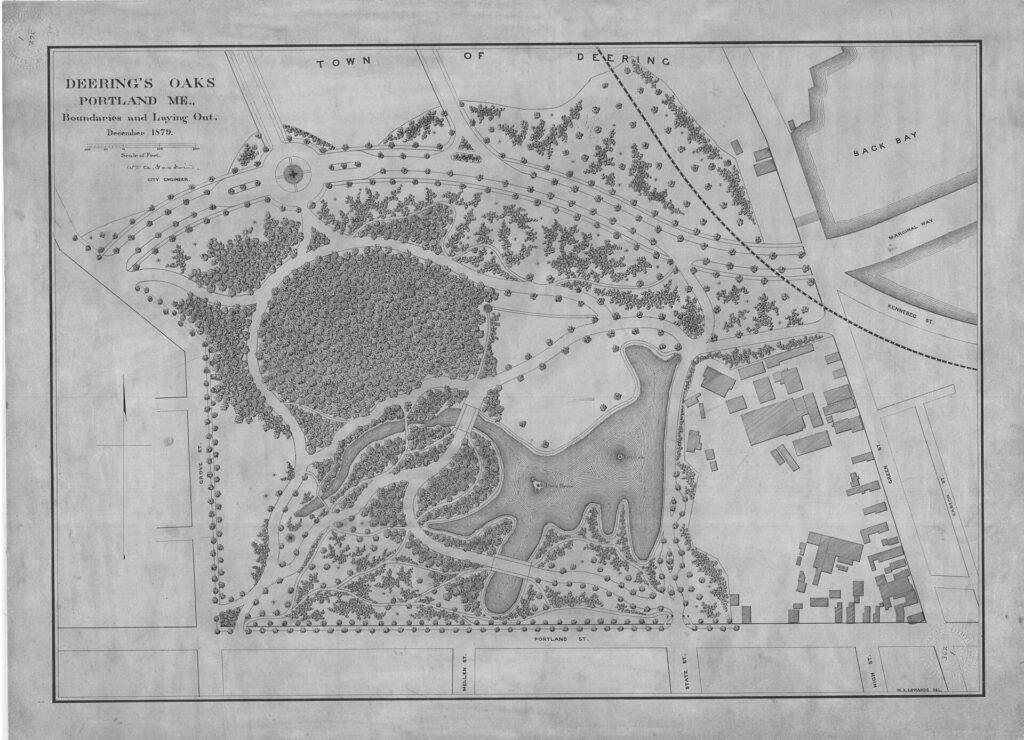
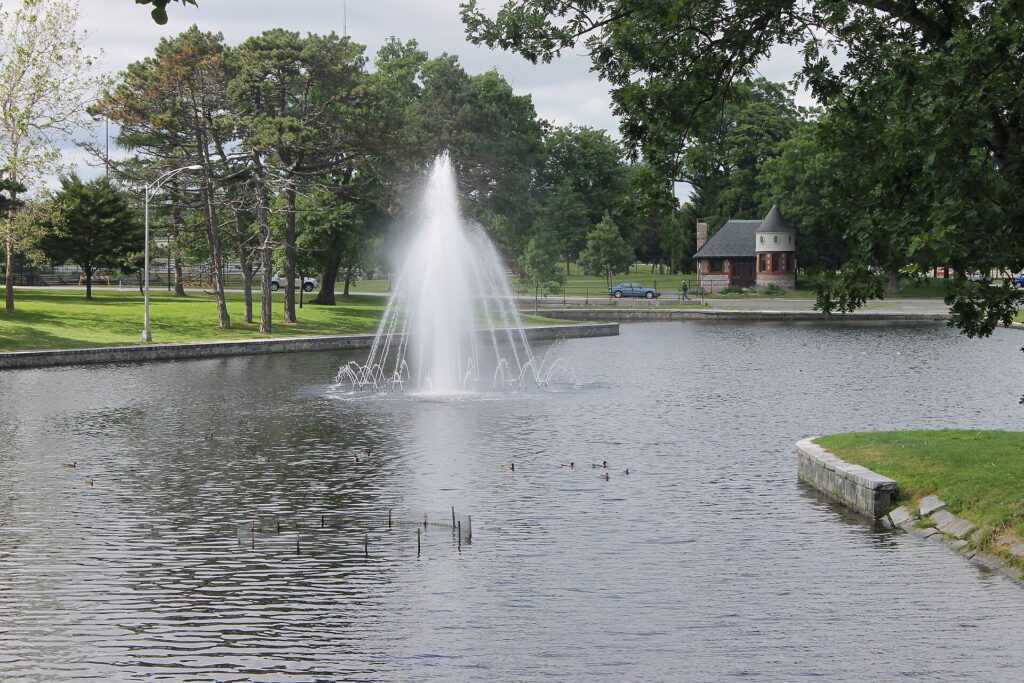
The pond was originally a tidal basin connected to Back Cove. Late 19th-century road construction cut off the tide. The Castle in the Park was built in 1894 as a skaters’ warming hut, and the footbridge over the ravine was built in 1911 for $3,355, according to Wikipedia. The Friends group says the rose garden was designed in the early 1930s by Parks Engineer William Dougherty, and that its native trees include one more than 200 years old. Portland’s City Council unanimously approved a master plan for the park in 1994, which the Friends group says is now about two-thirds complete.
What is in the park
- The pond: the park’s centerpiece. After the city secured federal money for algae problems, the pond bottom was lined with cement, per Wikipedia. The Friends group runs an annual lighting display around it.
- Castle in the Park: restored in 2004, per Wikipedia. The Friends group says it now has year-round use and staffed restrooms.
- The ravine and splash pad: a children’s play area. Wikipedia says it was redeveloped in the 21st century with a splash pad and a sculpture, “The Circle of Life” by Carole Hanson. The Friends group calls it a wading pool.
- The footbridge: the 1911 bridge over the ravine.
- Playground, ball fields and courts: baseball diamonds, tennis courts and a playground. The Friends group says a natural play space is being planned.
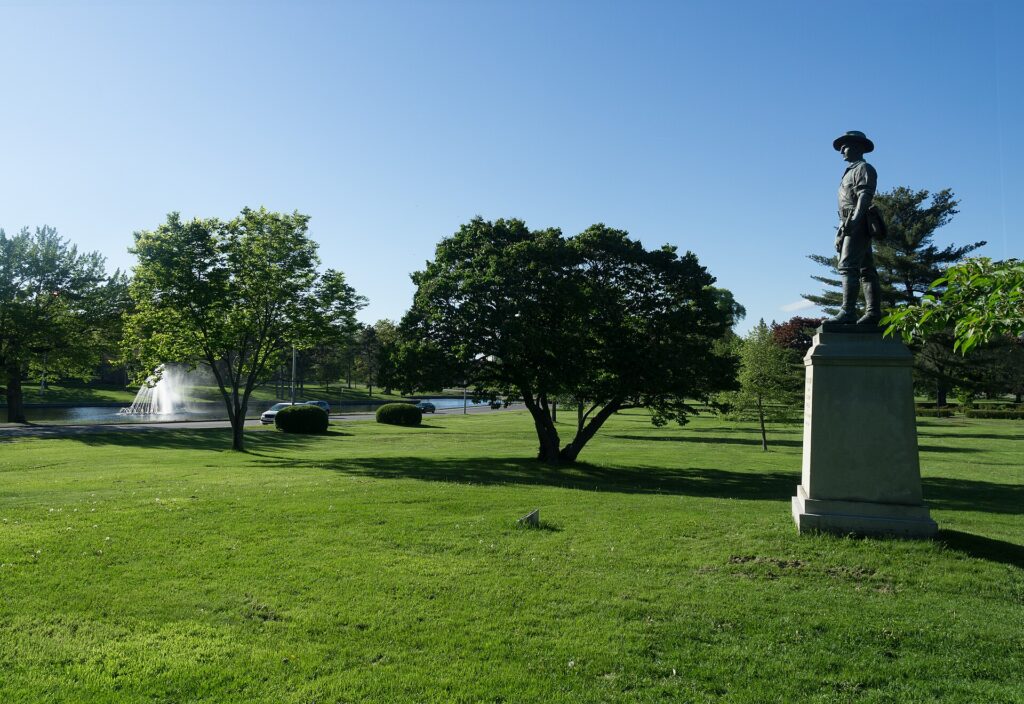
- Spanish-American War monument: it includes a casting of Theo Alice Ruggles Kitson’s The Hiker, per Wikipedia.
- Rose garden: the Friends group lists it among its projects.
Wikipedia adds that ice skating was historically offered in winter and paddle boats were rented in summer until the late 1990s. We did not find current information on either.
Tennis and pickleball courts
The city’s recreation page lists 8 tennis courts and 8 pickleball courts at Deering Oaks. Open pickleball play runs daily, approximately 8 a.m. to 1 p.m., and players put their paddle in a queue. Tennis courts 1, 4 and 5 and pickleball courts 5A and 5B are walk-up only. The other courts can be reserved one to seven days ahead, first come, first served, and at least 25 percent of the courts are drop-in only. The posted rental fee is $25 an hour for residents and $30 for non-residents, on a schedule that runs through December 31, 2026, so check the city page for current rates.
Portland Farmers’ Market at Deering Oaks
According to the Friends group, the Portland Farmers’ Market is held on Saturdays in Deering Oaks. It has about 20 farmers, each with a booth representing one farm in southern Maine. The season runs from early spring, when farmers sell flowers, into harvest time. The page does not give hours or an end date, so confirm both. It says each farmer pays the city $80 for a permit that also covers Wednesdays in Monument Square, and Wikipedia says the market operates from the Park Avenue side.
Getting there and parking
Wikipedia says the park’s main access is from State Street, Deering Avenue and Park Avenue. We did not find sourced information on parking, dog rules or park hours, so check the signs posted at the park and the city’s own page.
Why the sources disagree
- Who designed it. Wikipedia says the park was established as part of Olmsted’s master plan for Portland, that city engineer William A. Goodwin oversaw its development, and that its National Register entry lists the Olmsted Brothers. A visitor tip on Komoot credits Goodwin alone and describes a naturalistic style.
- What the Castle cost. Wikipedia says the 2004 restoration cost $675,000 and was funded by the Friends group. The Friends’ own page says its fundraising raised about $310,000, roughly 40 percent of the cost. The sources do not reconcile the two.
- When the pond money came. Wikipedia puts the federal grant for the pond in 2010, while the Friends group says federal funds were secured in 2009.
- Splash pad or wading pool. Wikipedia calls the ravine’s play area a splash pad. The Friends group calls it a wading pool.
Deering Oaks Park: FAQ
How big is Deering Oaks Park?
55 acres, or 22 hectares, according to Wikipedia.
When was Deering Oaks established?
In 1879, when the city formalized an agreement with the Deering family, per Wikipedia.
Who designed Deering Oaks Park?
Sources differ. Wikipedia says it was part of Frederick Law Olmsted’s master plan for Portland’s parks, with city engineer William A. Goodwin overseeing development.
What is the Castle in the Park?
A building from 1894, originally a skaters’ warming hut, that was restored in 2004. The Friends group says it now has staffed restrooms and year-round use.
Does Deering Oaks have a splash pad?
Wikipedia says the ravine was redeveloped with a splash pad and a sculpture. The Friends group calls it a wading pool. We did not find the season.
Are there pickleball courts at Deering Oaks?
Yes. The city lists 8 pickleball courts, with open play daily from approximately 8 a.m. to 1 p.m.
When is the farmers’ market at Deering Oaks?
On Saturdays, according to the Friends of Deering Oaks. Confirm the hours and season before you go.
Is Deering Oaks on the National Register of Historic Places?
Yes. It was listed on October 16, 1989, per Wikipedia.
Our details come from Wikipedia, the Friends of Deering Oaks (about, projects and farmers’ market pages), the City of Portland’s recreation page and Komoot. Hours, fees and events change, so confirm before you go.