Check the Aurora Right Now
Below is the latest planetary Kp reading from NOAA’s Space Weather Prediction Center. It loads when you open the page, so it shows conditions right now.
For the full forecast, use NOAA's aurora forecast for tonight and tomorrow night, which NOAA labels experimental.
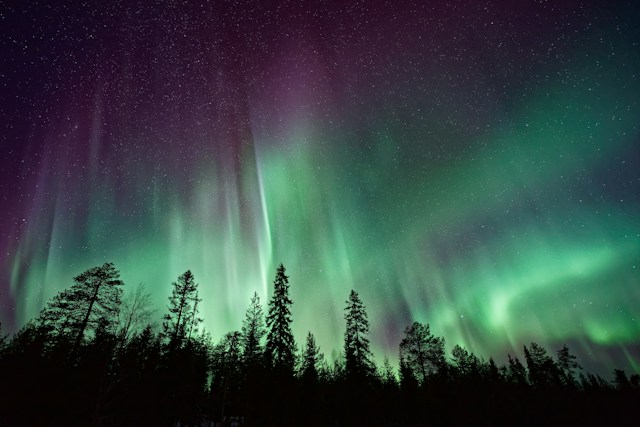
Yes, you can see the northern lights in Maine, but it takes the right night and the right place. Maine sits far enough south that the aurora usually shows low on the northern horizon, and it appears overhead only during strong geomagnetic storms. Your odds improve a lot the farther north you go and the farther you get from town lights. Aroostook County, the northernmost part of the state, is the best bet.
Quick answer: Yes, you can see the northern lights in Maine, but it is an event, not a nightly show. You need a strong geomagnetic storm, a clear dark sky and a spot away from town lights. Northern Maine, especially Aroostook County, gives the best odds, and October through April is the usual window.
The Northern Lights in Maine at a Glance
- Best months: October through April, with the longest nights from December through March
- Best place: Aroostook County, then the Katahdin Woods and Waters and Baxter State Park area
- Kp to watch: about 5 to 6 for northern Maine, and about 7 for the midcoast, Acadia and Portland
- Best hour: many guides suggest after midnight, on a night with little moonlight
- Winter access: Baxter State Park has no drive-up winter access, so plan on skis, snowshoes or a snowmobile
What Kp Level Do You Need?
The Kp index measures geomagnetic activity on a scale of 0 to 9. NOAA's storm scale maps the higher levels to G1 through G5: Kp 5 is a G1 storm, Kp 6 is G2, Kp 7 is G3, Kp 8 is G4 and Kp 9 is G5. Here is what forecast guides say each level can reach in Maine. Treat it as a range, not a promise.
- Kp 4: a faint glow in far-north Aroostook County at best
- Kp 5 (G1): a low glow on the northern horizon in Aroostook County and the North Woods
- Kp 6 (G2): reaches mid-state, including the Moosehead area, Baxter State Park and the Downeast coast
- Kp 7 (G3): reaches most of Maine, including the midcoast and Portland, from a dark spot away from town lights
- Kp 8 and up (G4 and G5): possible across the whole state, with brighter displays overhead
A higher number raises your odds. It never guarantees a sighting, because clouds, moonlight and town lights still decide what you see.
Why the Sources Disagree
Guides do not agree on the exact number. Maine.com's forecast guide puts a low glow in Aroostook County at about Kp 5 and the midcoast and Portland at about Kp 7. Other guides we checked put northern and central Maine at about Kp 6 and Bar Harbor and the southern coast at about Kp 7. The gap is about one Kp level. That makes sense, because Kp is a planetary average, while what you see depends on your latitude, your sky and the moon. We use Kp 5 to 6 as the range for northern Maine.
Best Time to See the Northern Lights in Maine
Sources differ a little on the window. Visit Aroostook says October through April generally offers the best viewing because the nights are longer and darker, and other guides put the darkest skies at December through March. Fall and early spring can also work, though spring tends to be cloudier. Summer nights are short, so the odds are very low.
Whatever the month, you need a clear sky and a dark one. Check the moon phase and aim for nights with little moonlight, and many guides suggest heading out after midnight.
Best Places to See the Northern Lights in Maine
Aroostook County
Aroostook County borders Canada, has few people and little light pollution, and is widely seen as the best place in Maine for the aurora. Visit Aroostook points to these spots:
- Aroostook National Wildlife Refuge
- Frenchville Dark Sky Observatory in the St. John Valley, which holds regular astronomy events
- Francis Malcolm Science Center in Easton
- Aroostook State Park
- Mars Hill Mountain, for an overlook
- Portage Lake and Long Lake, for open lakeside views north
For lodging and things to do, see our Presque Isle guide, things to do in Presque Isle and the Northern Maine guide.
Katahdin Woods and Waters and Baxter State Park
Katahdin Woods and Waters National Monument is an International Dark Sky Sanctuary. When the International Dark-Sky Association named it in 2020, it was described as just the 12th such place on Earth and the only one in the eastern United States. Baxter State Park, next door, is another top pick for winter stargazing and aurora photography. Millinocket is the usual base town.
Plan the winter access first. According to Baxter's winter use booklet, the plowed public roads end at Millinocket Lake in the south and at the Matagamon parking lot in the north, and the Matagamon gate is about 2.5 miles beyond that lot. You reach the park on foot, skis or snowshoes, or by snowmobile on the Park Tote Road. Overnight users from December 1 through March 31 need campsite reservations. See our Baxter State Park guide and read the park's winter rules before you plan a night trip.
Acadia and Downeast Maine
Acadia National Park has wide views to the north, and Cadillac Mountain, Sand Beach and Jordan Pond are popular night-sky spots. Light from Bar Harbor can interfere. The aurora is less likely here than in the north, so think of it as a bonus on a strong storm night. Acadia is better known for the Milky Way, which is best in July and August, and for its Night Sky Festival each September. Cobscook Bay State Park hosts the Maine State Star Party each August. Event dates change from year to year, so check with the organizers.
Western Maine and the Midcoast
The Appalachian Mountain Club's Maine Woods, in the 100-Mile Wilderness, is an International Dark Sky Park. The International Dark-Sky Association called it the first in New England when it was designated in 2021. Farther south, Mount Battie in Camden Hills State Park is a good night-sky spot, though the aurora there needs a strong storm.
Portland and Bangor
These are the hardest places. City light and a more southerly position mean you will likely see at most a faint glow, and only on the strongest storm nights. Drive north or away from town instead.
How to Find Out When the Lights Are Out
- NOAA's aurora forecast for tonight and tomorrow night, plus its 30-minute and 3-day forecasts
- The University of Alaska Fairbanks aurora forecast
- The Maine Aurora Watch Facebook group, where members share real-time sightings and conditions
- Apps such as My Aurora Forecast
- A light pollution map for Maine, such as Clear Dark Sky's, to find dark spots near you
Tips for Seeing and Photographing the Aurora
- Find a dark spot with a clear view north, away from house lights, streetlights, headlights and lit campgrounds.
- Check the local cloud forecast, since clouds block even a strong display.
- Dress warmly. Winter nights in the north are well below freezing, so tell someone where you are going.
- Give your eyes about 20 minutes to adjust, and keep white light off.
- Be patient. Some nights bring only a faint glow.
- Use a tripod and a long exposure, or your phone's night mode, to capture faint aurora.
Planning the Trip
From Portland, our tracker lists about 5 hours 30 minutes to the Aroostook County area and about 4 hours to Greenville and Moosehead. Use our Maine driving distances guide to plan the route. Because the lights depend on both the sun and the weather, build the trip around other winter activities so a cloudy night does not ruin it. See Maine in Winter and snowmobiling in Maine for ideas, and Maine in December for what to pack.
Frequently Asked Questions
Can you see the northern lights in Maine?
Yes, especially in northern Maine and during strong geomagnetic storms. It is an event, not a nightly show, so you need a clear, dark night and a good forecast.
What is the best month to see the northern lights in Maine?
Guides generally point to October through April, with the longest nights from December through March. Pick nights with little moonlight and clear skies.
Can you see the northern lights in Portland or Bar Harbor?
Rarely. You would need a strong storm, a dark spot and a clear northern horizon, and in Portland you may see only a faint glow. Bar Harbor needs a stronger storm than northern Maine does.
What is the best place in Maine to see the aurora?
Aroostook County, followed by the Katahdin Woods and Waters and Baxter State Park area. Both have dark skies and open views north.
How do I know when the northern lights will be visible?
Watch NOAA's aurora forecast and storm alerts, and join the Maine Aurora Watch group for live reports. Plan around Kp 5 or 6 or higher for northern Maine, and use the live reading near the top of this page to see where things stand now.
Does a high Kp number guarantee I will see the northern lights?
No. Kp is a planetary average. Clouds, moonlight, town lights and your latitude still decide what you see from your spot.
Can you see the northern lights in Maine in summer?
Rarely. Summer nights are short and the sky stays bright late, so the odds are very low compared with October through April.
What We Couldn't Find
- We did not find a Maine-specific Kp threshold from NOAA itself. The numbers above come from forecast guides and differ by about one level.
- We did not find a reliable count of how many nights a year the aurora is visible in Maine.
- We did not find night-time access rules for every spot listed here, so check with the park, refuge or landowner before you go.
Our details come from NOAA's Space Weather Prediction Center, Visit Aroostook, the International Dark-Sky Association, Maine Public, Baxter State Park's winter use booklet and Maine.com's northern lights forecast guide. Kp thresholds are rough guides and change with conditions.
MaineGuide.com has been helping people visit, move to and work in Maine since 1995. We are part of a Maine network that includes JobsInMaine.com, connecting Maine employers and job seekers since 1997.